
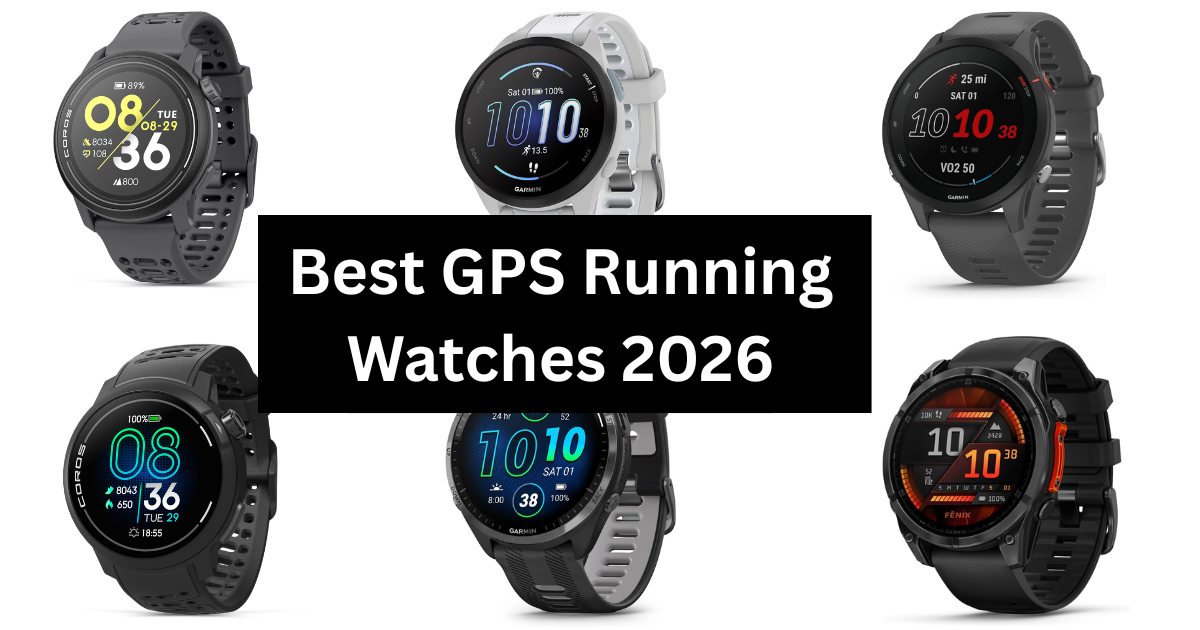
The six best GPS running watches for 2026 organized by price tier so that you can find the right watch for your budget.
By Sarah Okafor, Contributing Editor | Last Updated: February 2026 | 18 min read
Buying a GPS running watch in 2026 is weirdly harder than training for a marathon (okay not really). There are more models than ever, every brand is throwing out bold claims like “next-gen accuracy,” and prices range anywhere from “impulse buy” to “rent money.” If you are doing research on which one to get, my guess is that you probably have 3 tabs opened currently with information on various models. Fret not, I have a list of the top recommended ones across every budget so that you know which is actually worth strapping to your wrist.
After testing numerous GPS watches, one lesson stands out to me: battery life matters more than almost anything else for runners. You can have the fanciest watch with pipoint-accuracy maps, music storage, contactless payments, and a beautiful touchscreen display, but if the battery dies halfway through your long run because you forgot to charge it the night before, none of those features matter. I’ve been burned by this enough times that battery life has become my number one consideration when recommending watches, and it should probably be yours too.
The good news is that GPS watch technology has reached a point where even budget watches offer excellent battery life and accurate tracking, which means you don’t need to spend $600 or more to get a reliable training tool. The bad news is that there are too many options and marketing makes it hard to figure out which features you actually need versus which features are just nice to have.
The aim of this guide is to help you navigate through all that noise and give you some options across three different price tiers with my honest assessments pulled from real testing data. I will describe what each watch does well and what it doesn’t so that you can make an informed decision based on your budget and actual training needs.
How This Guide Is Organized
✓ Budget tier: Under $300 for runners who want solid basics with good battery life
✓ Mid tier: $300 to $400 for runners who want more features without breaking the bank
✓ Premium tier: $600+ for runners who want to pamper themselves with the absolute best (pro features included)
Budget Tier: Watches Under $300
Budget GPS watches have gotten shockingly good in the past few years, to the point where I genuinely think most recreational runners would be perfectly happy with a watch in this price range and wouldn’t benefit meaningfully from spending more. These watches track your runs accurately, give you training metrics that matter, and have battery life that makes expensive watches look embarrassing. What you give up compared to more expensive watches is screen quality in some cases, advanced features like full mapping, and some of the fancier training analytics, but for the core function of tracking your runs and helping you train smarter, these watches absolutely deliver.
Coros Pace 3 — The Affordable Battery Life King
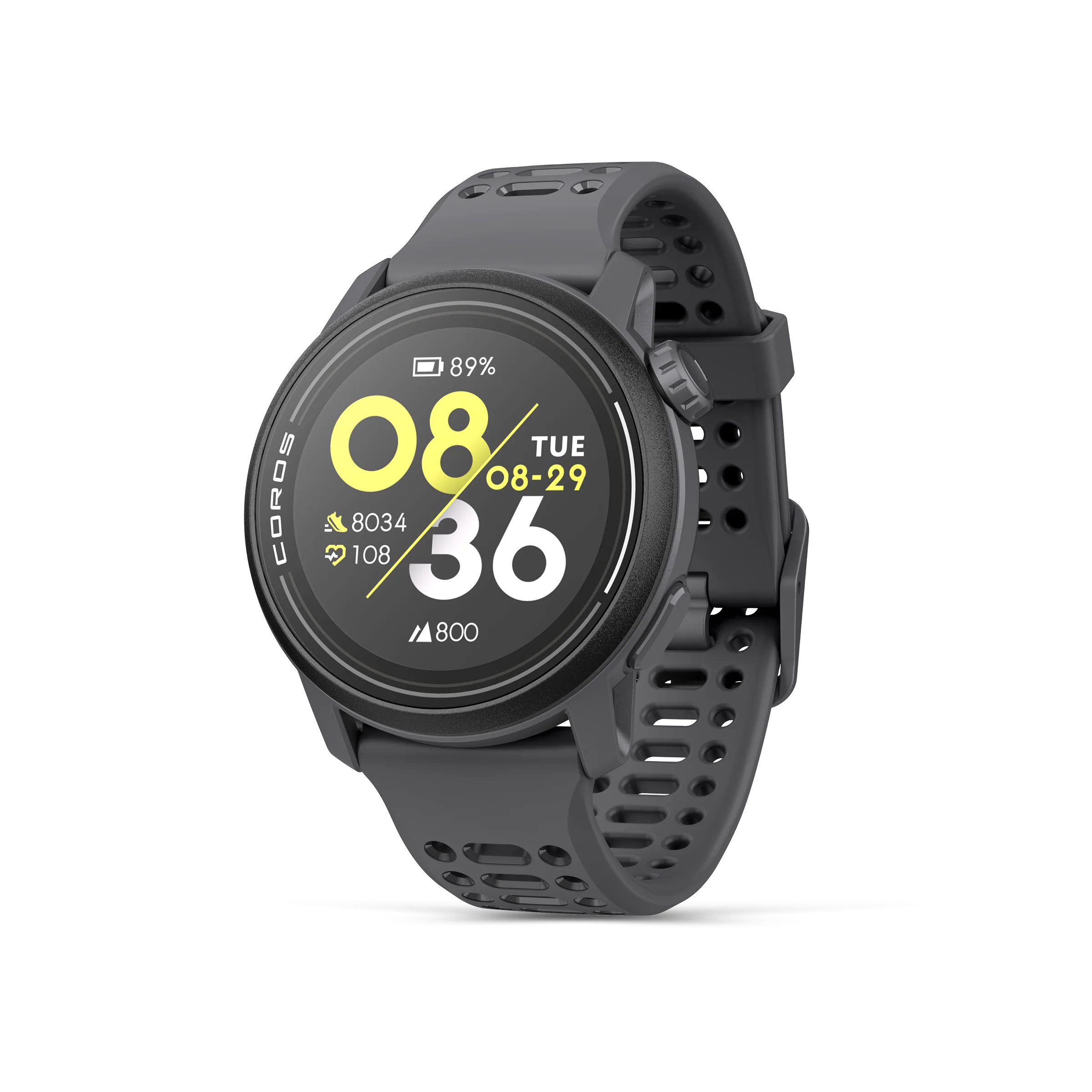
The Coros Pace 3 costs $229 and delivers battery life that makes watches costing three times as much look pathetic. We’re talking 24 days in smartwatch mode and 38 hours in full GPS mode, which is absolutely bonkers for a watch at this price point. For context, during a 12 and a half hour mountain hike with navigation enabled and dual frequency GPS turned on (the highest accuracy GPS setting possible), this watch burned through only 66% of the battery. According to Coros’s own charts it should have been closer to 90%, which means that its real-world battery life is actually better than what they claim.
Beyond battery life, the Pace 3 has dual frequency GPS which is considered the holy grail of GPS accuracy and something you typically only see on watches costing $500 or more. In testing across forests, city streets with tall buildings, mountains with steep cliffs, and open water swims, the GPS accuracy was very solid and easily better than Coros’s own higher end watches like the Vertex 2 or Apex 2 Pro. The dual frequency GPS made a tremendous difference in accuracy, especially on tight switchbacks in the mountains where it stayed within one or two meters of the actual track despite going around hairpin turns at speed.
The watch also has a new optical heart rate sensor that’s supposed to be more accurate, plus SpO2 monitoring that’s certified medical grade, though you do want to keep your hand still on a desk when using it because that’s how these sensors are certified. Coros added HRV tracking in a public beta update shortly after launch, so you can now track heart rate variability overnight to monitor recovery, though the feature is still being refined. There’s also a touchscreen on this watch, though it’s only enabled by default in navigation and activity menus, not in the general interface.
One nice detail is that Coros added music playback with 4 gigabytes of storage for MP3 files. You’ll need to connect it to your computer to download music since there’s no Spotify or streaming services, those doors closed years ago for smaller companies like Coros, but if you’re fine with MP3s you can leave your phone at home on runs. The bands were increased slightly to 22 millimeters versus 20 millimeters on the Pace 2, which makes them feel a bit nicer, though if you choose the white nylon band like I did it will slowly turn beige and yellowy over time despite washing it in the shower with soap.
The downsides are that training metrics like race predictions and recovery time are mostly hot garbage and don’t really line up with reality. During testing, the watch predicted a 5K time of 22 minutes 8 seconds but during testing, the fastest 5K section within a 30K easy run was 22 minutes 50 seconds which makes no sense. If those predicted numbers were accurate you would expect the race prediction to be in the 19 minute range or lower, not just a tiny bit slower than what you can run during an easy long run. Coros seems to have copied these metrics from other companies but didn’t understand the underpinnings of how they’re calculated, so there are inconsistencies across the board.
Navigation is also very basic, just breadcrumb trails with turn by turn alerts that are in public beta and not fully baked yet. Many turn prompts are missing entirely, the ones that do appear don’t show distance to the turn, and the turn banners disappear after just a couple seconds. If you’re only sparingly using navigation it’s fine, but if you lean heavily on it you’ll want something else. Heart rate accuracy outdoors while cycling was also a complete dumpster fire in testing, though everything else including running and indoor cycling was solid.
Best for: Runners who prioritize battery life above all else and don’t need fancy features or perfect training metrics.
Price: $229
Battery: 24 days smartwatch, 38 hours GPS (dual frequency)
Weight: 30g (with fabric band)
Key Feature: Dual frequency GPS at budget price
Garmin Forerunner 165 — The Budget AMOLED
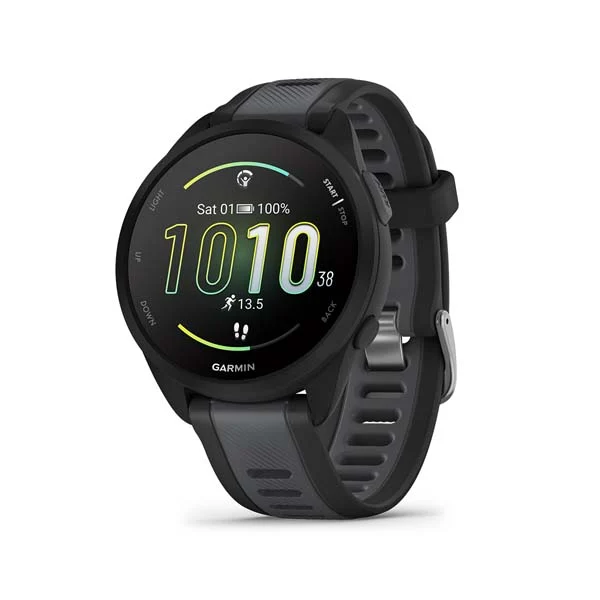
The Forerunner 165 costs $249 for the base edition or $299 for the music edition, and it’s the cheapest Garmin Forerunner that has an AMOLED display. That display is gorgeous, a color touchscreen that you can swipe through, and it makes the watch feel way more premium than the price suggests. This sits below the higher end Forerunner 265 and 965, and the main thing you’re giving up compared to those watches is training readiness features, but you’re getting nearly everything else at half the price.
Battery life in real world testing is 4 days with always on display and doing 1 to 2 hours of GPS workouts per day, which is solid though less than what the Coros Pace 3 delivers. There are two display modes, always on means the display stays on but dimmed when your wrist is down, and gesture based means it’s off until you raise your wrist. The watch has Garmin’s Elevate V4 optical heart rate sensor, which isn’t their newest Gen 5 sensor, so you won’t get ECG functionality, but for most runners that doesn’t matter at all.
The watch has all systems GPS, not multiband or dual frequency like you’d find on the Forerunner 265, but in testing the GPS accuracy was excellent and easily beat the vast majority of other companies’ higher end dual frequency configurations. It was virtually identical to Garmin’s own multiband watches, so I wouldn’t worry about the lack of multiband at all. On city runs with 20 to 30 story buildings and tight streets, the GPS was spot on, better than expected honestly, and in the mountains with cliffs towering overhead it nailed the tracks without problems.
You get VO2 max estimates with 5K and 10K race predictions, recovery time advisor, HRV status tracking for monitoring fatigue over time, body battery for tracking energy levels throughout the day, and daily suggested workouts that automatically adjust if you have poor sleep for multiple days. The watch also has a race calendar feature where you can add races and it will build out an entire training plan for you automatically, including base phase, build phase, peak phase, taper, and recovery. It adjusts your long run day based on your preferences and pauses training if you get sick or go on vacation.
One massive difference between this and the Forerunner 265 is the lack of training readiness. Training readiness is Garmin’s umbrella metric that combines sleep, recovery time, HRV status, acute load, sleep history, and stress history to give you a readiness score for whether you should train right now. The 165 doesn’t have that, it only has recovery time and VO2 max estimates, which is a significant gap if you’re trying to optimize training load and avoid overtraining. The 165 also doesn’t have multisport or triathlon mode, and it doesn’t have cycling power meter support, though it does have native running power from the wrist.
The watch supports unlimited customizable data screens, which is a huge advantage over the Vivoactive 5 that only allows three screens. You can have as many data pages as you want with up to six data fields per page even on the smaller 265S version, which is impressive for a display this size. Music edition supports offline Spotify, Amazon Music, Deezer, MP3s, and podcasts, and playlists auto update when you charge the watch via WiFi.
Heart rate accuracy was mixed in testing. It got most hard intervals right but struggled with a few, and it had some lag at the beginning of workouts especially in cold weather, which is normal for optical sensors. During mountain biking it struggled until it warmed up, then it was incredibly impressive for the rest of the ride. Overall the accuracy is good enough for training but not perfect.
Best for: Runners who want an AMOLED display and Garmin’s ecosystem without paying Forerunner 265 prices.
Price: $249 (base) / $299 (music)
Battery: 4 days always on display with 1-2 hours GPS daily
Weight: Not specified
Key Feature: Cheapest Garmin AMOLED display
Mid Tier: Watches $300 to $400
The mid tier is where things get interesting because you’re making trade offs between brands, features, and philosophies. Do you want an AMOLED display with shorter battery life, or do you want a MIP display with battery life measured in weeks? Do you want full topographic maps, or can you live with breadcrumb trails? Do you want training readiness metrics, or is recovery time enough? These watches cost roughly the same but deliver very different experiences, so you need to know what matters to you.
Garmin Forerunner 255 — The Multisport Workhorse
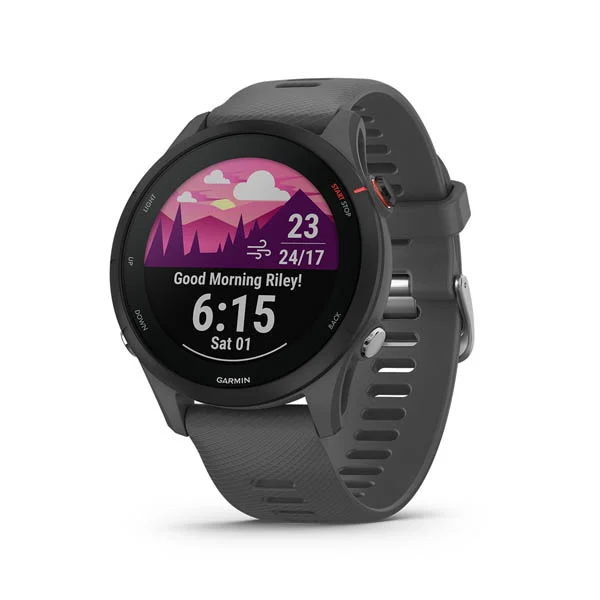
The Forerunner 255 costs $349 for the non music edition and $399 for the music edition, and it represents a massive upgrade from the 245. This is the first time Garmin added full multisport and triathlon support to a watch at this price point, so you can string together swim, bike, and run into one cohesive activity. It also supports cycling power meters and indoor trainers, making this a full triathlon watch at a very reasonable price.
The biggest feature here is multiband or dual frequency GPS, which I did not expect to see at this price point, but Garmin went all in on this technology. Multiband GPS is considered the holy grail of GPS accuracy, and in testing it was astounding how good it was. Running in the business district with 20 to 30 story buildings on tiny streets going back and forth, it locked the track almost perfectly. Compared to the 945 LTE, Coros Vertex 2, and Polar Pacer Pro, none of those watches held a candle to either the 255 or the 955, they were leagues apart in terms of accuracy.
Garmin also added a barometric altimeter to this watch, the first time we’ve seen a Forerunner watch anywhere near this price point have one. This gives you more accurate elevation data than GPS based altimeters, though you won’t get Climb Pro on this watch, that feature is reserved for higher end models like the 745 or 955. The barometric altimeter also enables semi native running power, though you still need a Garmin accessory like the HRM Pro chest strap, HRM Run, HRM Tri, or the RD pod to actually see running power on the screen.
One of the biggest new features is nightly HRV tracking. You need 19 days or roughly three weeks of data before it shows your HRV status in color coded zones, and those zones are custom to you based on how variable your values are night to night. It’s established after 19 days and then goes out to 90 days worth of data, so it’s always comparing against much longer trends. Many factors influence HRV including alcohol, sleep, fatigue, training, recovery, stress, and illness, and the point is to look at longer term trends rather than freaking out about one bad night.
There’s a new morning report that shows your sleep stats, HRV status, weather, and any structured workouts on your calendar. It’s become one of the most popular features on Garmin watches and it looks really nice on the color display. There’s also a new race widget system where you can add races to your Garmin Connect calendar and it will automatically build out your entire training plan even if you don’t know it’s doing it. When you add a race, it creates daily suggested workouts tailored to that race distance and date, including base phase, build phase, peak phase, taper, and the race itself.
The 255 has training status metrics that have been overhauled compared to the past. Garmin heard feedback that people were tired of the “unproductive” message, so they redesigned training status to focus more on coaching rather than just telling you you’re doing it wrong. It looks at VO2 max trends, HRV status balance, and acute load, which is your training load over the last 7 days with older workouts burning off over time so they’re less impactful to your current state.
Battery life is claimed at 14 days in smartwatch mode and 30 hours in GPS mode, which is double what the 245 had. In real world testing with 1 to 2 activities per day, you’re looking at about 7 to 10 days realistically, which is very solid for a watch with all these features. The display is a MIP reflective display, not AMOLED, so it’s always on and extremely visible in direct sunlight but doesn’t have the brilliant colors and sharpness you’d get from an AMOLED.
There are two sizes, a 46 millimeter and a 42 millimeter, and within each size there’s a music edition and non music edition. The features are identical across all four versions, the only differences are size and whether you have music storage. The watch uses standard Garmin charging cable, not USB-C, which is a minor annoyance.
Heart rate accuracy in testing was pretty good overall. During steady state runs it was spot on, during tempo runs it was virtually identical to a chest strap, and during indoor trainer rides with hard intervals it was perfect. Outdoor cycling had a couple minor wobbles but overall very acceptable for an optical sensor. GPS accuracy was excellent across the board, from forests to cities to mountains, it nailed everything.
Best for: Triathletes and multisport athletes who want premium features without paying $600.
Price: $349 (non music) / $399 (music)
Battery: 14 days smartwatch, 30 hours GPS (multiband)
Weight: 49g (46mm version)
Key Feature: Multiband GPS and full triathlon support at mid tier price
Coros Pace Pro — The AMOLED Upstart
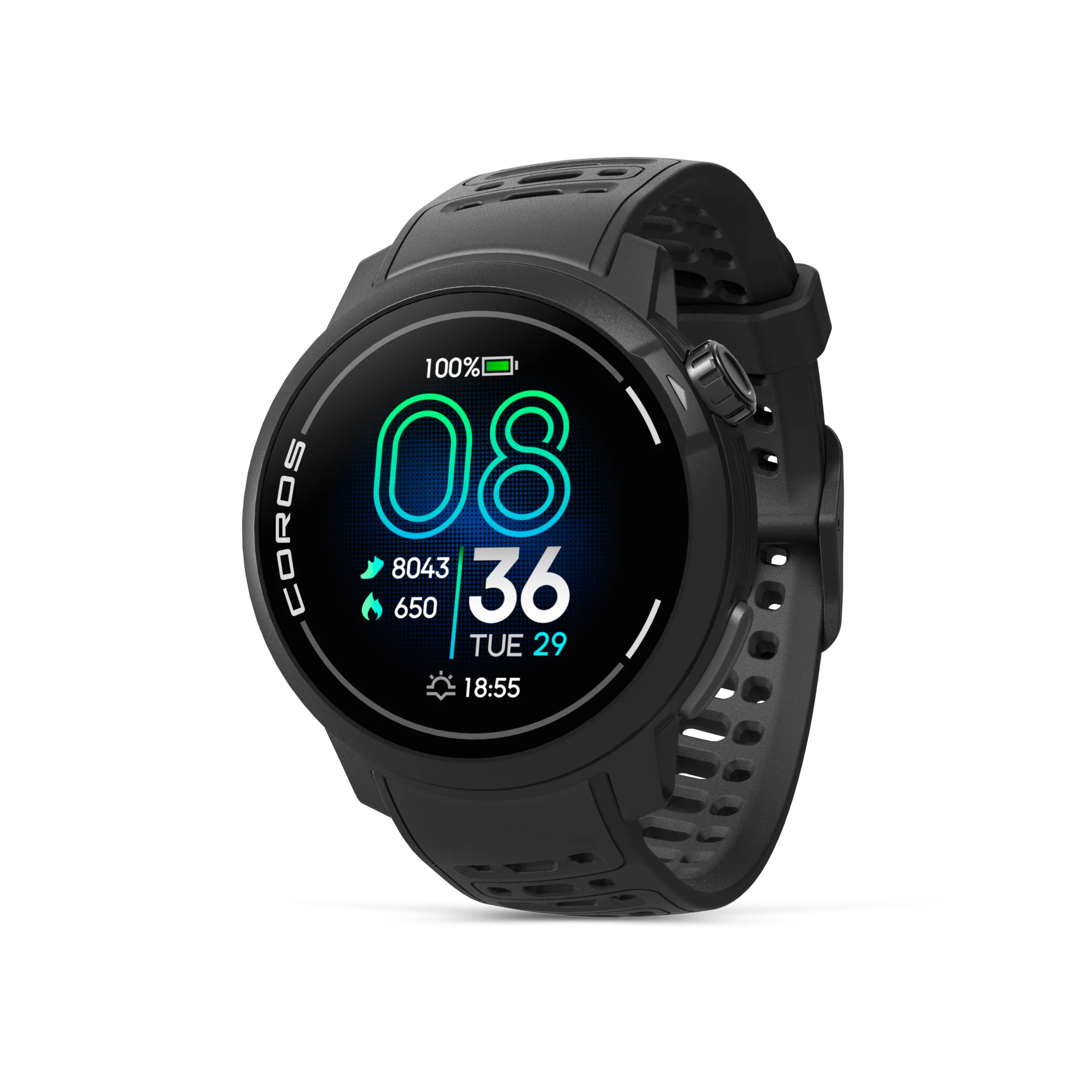
The Coros Pace Pro costs $349, a significant jump from the Pace 3’s $229, and honestly the pricing puts it in direct competition with the Forerunner 255, Suunto Race S, and Polar Vantage M3. This is Coros’s first watch with an AMOLED display, a 1.3 inch screen at 1500 nits of brightness, which is plenty bright whether you’re running in full sun or at night. The case size increased from 42 millimeters to 46 millimeters compared to the Pace 3, and the buttons are much larger and easier to hit during intervals.
Coros swapped the fabric band for silicone, which means the watch is heavier than the Pace 3, but I actually prefer the silicone band. The charging situation changed too, you no longer get a charging cable in the box, instead you get a keyring adapter and you supply your own USB-C cable. The charging connector on the watch is slightly deeper and thicker than past Coros watches, which means old cables won’t work unless you whittle down the rubber edge slightly, which Coros confirmed is technically fine though not ideal.
Battery life is claimed at 6 days for always on display and 20 days for gesture based display in smartwatch mode. With GPS, you get 38 hours in all systems mode and 31 hours in dual frequency mode. In real world testing with 1 to 3 hours of GPS workouts per day, battery life came in around 4 days in always on mode, which is pretty close to the claims. There’s no base GPS mode anymore, it’s either all systems or dual frequency, which means you’re getting better GPS accuracy across the board but burning more battery.
However, there was a significant GPS firmware bug discovered during testing where one outdoor ride burned 10% battery per hour, which would give only 10 hours of battery life in dual frequency mode. Coros found a race condition conflict in the GPS firmware that led to horrific battery life, and as a result they tweaked the GPS firmware for everyone to reduce accuracy slightly until they can resolve the issue with the chipset provider. With the new firmware, battery burn is about 5% per hour with navigation enabled, which works out to about 20 hours of battery life rather than the claimed 30 hours, though having navigation enabled definitely impacts things more than normal GPS tracking.
The big ticket feature is onboard mapping. The Pace 3 didn’t have maps, that was saved for the Apex and Vertex series, but the Pace Pro now has downloadable maps. You choose your region in the Coros app, tap to download, and it pulls maps via Bluetooth or WiFi. One thing I really like about Coros’s map system is you can download really small sections, like the entirety of Mallorca and nearby islands in only 60 megabytes, which is nothing compared to Garmin’s map sizes.
The maps are not routable, which means if you go off course it won’t route you back, you have to use the watch to figure out where you are and aim back to the trail yourself. There are no names on the maps today either, so no trail names, road names, or lake names, though Coros says that’s coming in Q1 next year. Turn by turn navigation works for some but not all turns, and the turn prompts that do appear don’t show distance to the turn and disappear after just a couple seconds. Overall the mapping works fine for getting through trails but it’s not as good as maps that have all the extra data and do routing.
Coros says they doubled the processor speed compared to the Pace 3 and made everything faster. Honestly in the menus there’s no difference, both watches are equally fast, but when scrolling through maps you definitely notice the Pace Pro is way faster at rendering compared to the Apex or Vertex series. They also increased storage from 4 gigabytes to 32 gigabytes, mainly for maps though you’ll never use all 32 gigs since Coros maps are so small. You can use it for MP3 music files but there’s no Spotify or streaming services, and there never will be because those castle gates closed years ago for small companies.
There’s a new optical heart rate sensor, the same one from the Vertex 2S, and it brings ECG functionality though it’s not medically certified by the FDA or CE European Union, and it doesn’t do AFib detection. It’s really just for looking at the squiggly line, don’t use it as a medical device. Coros also swapped out the GPS chipset and optimized the antenna design, and GPS accuracy in testing was definitely better than the past across different sport areas, though there have been a couple catches related to that firmware bug mentioned earlier.
Heart rate accuracy was very good for indoor cycling intervals, outdoor trail runs with lots of ups and downs, and structured short intervals of 2 minutes, 1 minute, and 30 seconds. There was a little bit of latency on the recoveries of some shorter intervals, which is somewhat common for optical sensors. However, outdoor cycling was a complete disaster, a dumpster fire across the board, way worse than most other watches. Everything else was great, so just get a chest strap if you’re cycling outdoors.
GPS accuracy was excellent. On interval runs around an area without tall buildings it was spot on, and on one particular turn that was repeated over and over the GPS lines were incredibly close each time, within a meter or two on a very narrow sidewalk. On a trail run with the newer reduced accuracy firmware there was a very slight offset of maybe 2 to 4 meters compared to other watches, not a huge deal but noticeable if you zoom in closely. On an outdoor cycling ride up in the mountains with steep cliffs and sharp 180 degree switchbacks, accuracy was really good and matched higher end bike computers without problems. Open water swimming was also pretty darn good, the first time Coros has managed a reasonably accurate open water swim session.
Best for: Runners who want AMOLED display with onboard maps and don’t mind Coros’s ecosystem quirks.
Price: $349
Battery: 6 days always on, 31-38 hours GPS
Weight: Heavier than Pace 3 due to silicone band
Key Feature: First Coros AMOLED with onboard mapping
Premium Tier: Watches $600 and Up
Premium watches are for people who want the absolute best of everything, which means the best displays, the best battery life for AMOLED, the most advanced features, the best build quality, and materials that feel expensive. These watches cost as much as a decent laptop, and for most runners they’re overkill, but if you’re training seriously or obsessed with having the best gear, these are the watches that justify their price tags with tangible performance advantages.
Garmin Forerunner 965 — The AMOLED Flagship
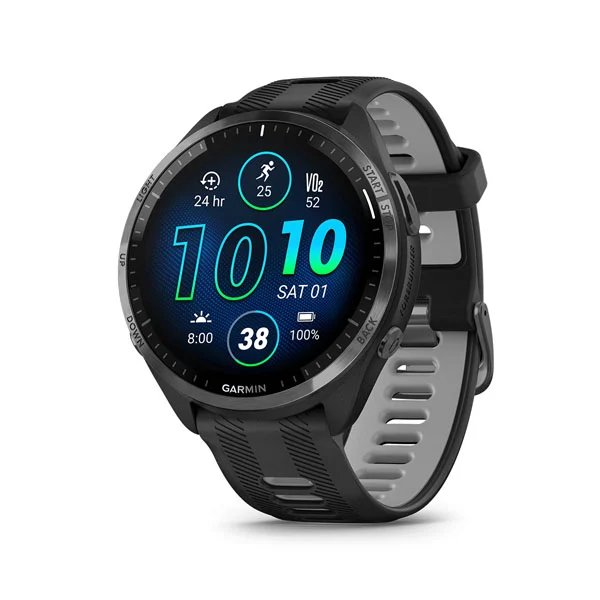
The Forerunner 965 costs $599 and is essentially the Forerunner 955 with an AMOLED display and a few software tweaks. The 955 was launched less than a year before the 965, so this is not a complete overhaul, it’s a display upgrade with some refinements. The display is a 1.4 inch AMOLED compared to the 955’s 1.3 inch MIP display, and the resolution increased by almost 4X based on pixel math. Despite the larger display, the case size is actually the same 47 millimeter case as the 955, and it’s a tiny bit thinner, dropping about 1.2 millimeters, though it is slightly heavier because of the titanium bezel added to the outside.
Battery life is the big question with AMOLED displays, and in testing the 965 delivered about 6 to 7 days in always on display configuration with one to two hours of GPS activities per day, which is very similar to what the Epix delivered. That’s nowhere near the 955’s battery life but it’s still way better than an Apple Watch or most other AMOLED watches. There was one particular review unit that had horrific battery burn, three times worse than expected, and Garmin sent a replacement unit that performed correctly, so there may have been a hardware defect in that first unit.
The software changes include a new feature called Chronic Training Load, which tracks your training load over 28 days instead of just the acute load’s 7 days. There’s also Training Load Ratio, which simply divides your acute load by your chronic load to give you a score. If both numbers are the same you get 1.0, if your current load is higher you get 1.1, 1.2, etc. The green zone is from 0.8 to 1.5, so it’s skewed toward the higher end. This is a nice feature for making the mental math easier but I wouldn’t call it a game changer.
They also added wrist based running dynamics, so you no longer need a chest strap or running pod to get metrics like ground contact time, vertical oscillation, and cadence. These are geeky running metrics that frankly no one has figured out how to actually use even after nearly a decade of availability, but hey, it’s there if you want it. The accuracy compared to a chest strap is very similar except when walking, where the wrist data separates from the chest strap data.
The 965 participates in Unified Training Status, which is a fancy term for Physio TrueUp 2.0, basically a way so that if you have multiple Garmin devices almost everything syncs properly and instantly back and forth. The entire user interface has also been revamped to look more refined, way better than the 955 interface, more 2023 looking I guess. They finally added a USB-C charging cable too, at least the side you plug into the wall, the watch side is still the standard Garmin connector.
What hasn’t changed is that it still has music with Spotify, Amazon Music, and MP3s for offline playback. It still has multiband GPS which is industry leading in accuracy. It still has full downloadable topographic maps so you can navigate without your phone. It still has daily activity tracking, sleep tracking, structured workout support, and everything else from the 955. What it doesn’t have is ECG, despite Garmin rolling out ECG to the Venu 2 Plus, this watch doesn’t have the hardware for it. It also doesn’t have voice, LTE, or cellular functionality.
The morning report looks a heck of a lot nicer on the AMOLED display, and there are cute little touches like showing fog through the trees on a foggy morning or sunny graphics on a sunny day. Training readiness is still here from the 955, showing you your readiness to train at any given moment based on sleep, stress, training load, and other factors. It’s become one of the most useful features because it does a much better job than training status did in the past at figuring out whether you should actually train or rest.
One minor downside is you can’t see training readiness numbers or training load numbers on any of the default watch faces, which is weird because the 955 had that and the 745 had that. Hopefully Garmin adds it in a minor update. You can still see those numbers by tapping down into the widget glances, but it would be nice to have them on the watch face itself.
Heart rate accuracy in testing was excellent for steady state running, tempo runs, indoor trainer rides with hard intervals, and most outdoor cycling. There was one run with 400 meter intervals followed by 200 meter intervals where the 965 really struggled, a bit late on the 400s and missing some of the 200s, while the 265 nailed everything across the board. That was an outlier though, overall heart rate accuracy is very good.
GPS accuracy was perfect across the board. In forests with dense tree cover and fog it was within a couple meters of other high end watches. In suburbia it stayed on the sidewalk exactly where it should be. On a road ride going back and forth many times on the same stretch, the GPS track showed the correct side of the road for northbound versus southbound, and on a tiny roundabout it stayed within one car width despite going around it multiple times. Running dynamics from the wrist were very similar to a chest strap except when walking.
Best for: Serious runners who want the best AMOLED display Garmin makes and don’t mind paying a premium for it.
Price: $599
Battery: 6-7 days always on with 1-2 hours GPS daily
Weight: 53g
Key Feature: AMOLED display with industry leading GPS accuracy
Garmin Fenix 8 — The Everything Watch
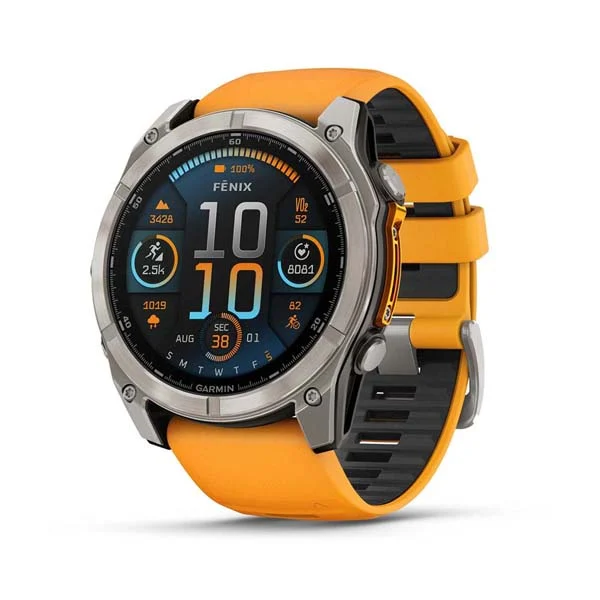
The Fenix 8 starts at $999 and represents Garmin’s consolidation of the Fenix and Epix lines into one branding. If you had a Fenix before, it’s now called Fenix 8 Solar with a MIP display. If you had an Epix before, it’s now just called Fenix 8 with an AMOLED display. The default for Fenix is now AMOLED, which makes sense because the Fenix and Epix always shared the same software, the only difference was display type and battery life.
There are three size options, 43 millimeter, 47 millimeter, and 51 millimeter, and you can choose AMOLED or MIP solar for the two larger sizes. The small size is AMOLED only, which is something that not everyone is happy about because some people loved the smaller Fenix 7S with the MIP display. Garmin says when they tried to fit all the new components into the small case it would have increased thickness by about 1.5 millimeters making it too tall and chubby, so the MIP option in small is gone. Screen sizes have increased across the board, especially on the mid sized model.
Battery life in testing was about 6 days in always on display configuration with primarily staying on data screens that were text based, using SatIQ auto select GPS which switches between multiband and regular GPS as needed, and doing 1 to 2 hours of GPS per day. On a 10 hour hike with navigation enabled, always on display, and SatIQ auto select, the watch burned through about 30% of the battery, which is actually better than Garmin’s specs. On an 8 to 9 hour hike where the navigation map page was left on the entire time, battery burn was much higher and ended up with about 18 hours total battery life.
The big hardware changes are the addition of a microphone and speaker. You can ask Google, Apple, or Samsung assistant things and get responses, and you can take phone calls from the watch though you need your phone with you since there’s no cellular. In testing the speaker volume was pretty quiet even at full volume, and there was some crackling. It’s usable but not great. There’s also a new Garmin offline assistant that works even without cellular connectivity, you long hold the upper right button and tell it what you want like start a run, save a location, set a timer, etc. It works pretty well most of the time but you have to hold a button, it doesn’t just respond to your voice like “Hey Siri” or “Hey Google.”
There’s also a voice notes feature where you can record notes that get geotagged, the idea being if you have a brilliant thought during a run you can save it for later. However, as of right now there’s no easy way to get those notes off the watch, they don’t sync to your phone, so it’s a bit thin in terms of implementation.
The second big feature is dive capability. Garmin took the dive functionality from the Descent Mark II lineup and stuffed it into the Fenix 8, or at least the vast majority of it. The hardware is good down to 100 meters but the software limits your dive depth to 40 meters, just like Apple does. If you go beyond 40 meters it stops telling your depth and says go back up. The vast overwhelming majority of dives worldwide are within 40 meters, probably 99.99% of dives, so this limitation won’t matter for most people. The watch has free diving and snorkeling modes, and it automatically starts a dive when you get below 4 feet of depth and ends it automatically after 5 minutes on the surface.
To support diving they added new leak proof buttons where there’s no hole from the button into the case, instead the button press uses an induction connection. This means the case is completely sealed. The buttons do feel a little different, not bad or better, just different, and it took a day or two to get used to the different button press feel.
The Fenix 8 Solar edition has changes to how solar works. In the past there were two solar panels, one around the outside of the display and one covering the display itself. That covering panel reduced visibility of the display somewhat. Now that’s gone, replaced by a far more powerful solar ring around the outside that’s black instead of red, so it blends in with the bezel and doesn’t look as obvious. This is the same technology on the new Enduro 3 except the Fenix ring is smaller.
The user interface has been completely revamped across the board. Some elements seem similar to the past but Garmin’s goal is to stop the craziness where every single watch line gets a different UI. This is the general direction going forward. The settings are much more consolidated with the most important and most used ones toward the top. Within each settings category things are more logically grouped than before.
When you start an activity, your pinned sports are at the top, then you have to tap into “Activities” to see the rest of the sports categorized by type. Below that is an “Apps” section for things that aren’t sports, like messenger if you have an InReach device, voice commands, phone assistant, and music. The new dashboard for sport profiles shows settings at the bottom when you scroll down, similar to what Suunto does.
There are three lanes along the bottom of the screen during activities. Swipe right for music controls, swipe left for settings or navigation if you have a course loaded. Your main data pages are in the middle and you scroll through them normally. There’s a new touch unlock option where you swipe down to temporarily unlock touch at any time, which is useful if you normally want touch disabled but need to interact with a map.
Other changes include a revamped notification center for both smartphone and Garmin notifications, map zoom levels now show as a radius along the top, you can easily toggle north view on maps with a single tap, and you can change map layers quickly including bird’s eye imagery. Round trip routing has been updated so if you tell it to create a 10K route and you wander off course to visit a polar bear or ice cream shop, it dynamically updates the distance to still give you 10K total.
Heart rate accuracy in testing was good overall. Steady state runs were spot on, tempo runs were virtually identical to chest straps, indoor trainer workouts with intervals were perfect, outdoor cycling had a couple minor wobbles but acceptable for an optical sensor. GPS accuracy was also excellent. In a seaside town with tight streets and 20 to 30 story buildings it was spot on. On a coastline route with cliffs and tunnels, tracks were identical to high end devices. In the mountains with huge cliffs towering overhead it was spot on. Open water swimming was identical to a reference track on a swim buoy.
The problem with the Fenix 8 is the price. At $999 starting point, that’s a 200 dollar increase for Fenix owners or a 100 dollar increase from Epix owners. If you set aside price, it’s a great watch with no technical complaints. GPS accuracy is excellent, heart rate monitor is good, dive mode works well, the interface is refined, battery life is solid for an AMOLED. But the big thing everyone has been asking for, cellular connectivity even for safety like the 945 LTE, isn’t here. For $999 you’re essentially getting two hardware updates, dive mode and microphone/speaker, plus user interface tweaks. That’s where I’m conflicted, the price relative to the new features doesn’t align in my mind. It’s a great watch if you’re willing to spend $1000 for it, but I think they overshot on the price.
Best for: Outdoor athletes who need dive capability, maximum features, and don’t mind spending $1000.
Price: $999+
Battery: 6 days AMOLED always on, weeks on Solar MIP
Weight: Varies by size and material
Key Feature: Dive capability and microphone/speaker in bombproof package
How to Choose the Right Watch for You
If you’ve read through the entire guide and still feel unsure over which one to buy, I’ll simplify things even more for you:
If battery life is your number one priority and you can live with basic features and somewhat wonky training metrics, get the Coros Pace 3. Nothing else at any price point comes close to 38 hours of GPS battery life with dual frequency GPS enabled, and 24 days of smartwatch battery is absurd. The GPS accuracy is excellent, better than Coros’s own expensive watches, and for $229 it’s a steal.
If you want an AMOLED display at the lowest possible price and you’re already invested in the Garmin ecosystem, get the Forerunner 165. You’re giving up training readiness compared to the 265 but you’re getting nearly everything else for half the price. The GPS accuracy is excellent despite not having multiband, the display is gorgeous, and the daily suggested workouts with automatic race plan generation make training so much easier.
If you want multiband GPS with great battery life at a reasonable price, get the Forerunner 255. It’s the cheapest way to get multiband GPS and full triathlon support, and the MIP display gives you 14 days of battery life even with 1 to 2 activities per day. The training status overhaul and HRV tracking make this a very complete package for serious training.
If you want onboard maps with an AMOLED display, get the Coros Pace Pro. The maps aren’t as fully featured as Garmin’s but they work fine for trail navigation, and you’re getting a 1500 nit AMOLED display with 31 to 38 hours of GPS battery for $349, which is very competitive. Just be aware that training metrics are less refined than Garmin’s and heart rate accuracy for outdoor cycling is terrible.
If you want the best AMOLED display Garmin makes with industry leading GPS accuracy and you’re willing to pay for it, get the Forerunner 965. This is the 955 with a gorgeous display and some software refinements, and while it’s not a massive upgrade, the AMOLED display makes everything feel more premium. Battery life is very good for AMOLED at 6 to 7 days with daily activities, and the GPS and heart rate accuracy are both excellent.
If you need dive capability or want the absolute most bombproof watch Garmin makes with every feature they offer, get the Fenix 8. It’s overpriced for what you’re getting in my opinion (especially since I am writing for a running publication), essentially dive mode and a microphone/speaker plus UI tweaks for a 200 dollar price increase, but if you’re willing to spend $1000 it’s certainly an excellent watch with no technical complaints. The lack of cellular is disappointing at this price point though.
Final Thoughts on Battery Life
I started this article by saying battery life matters more than fancy features, and after testing all six of these watches extensively I stand by that statement even more strongly. The Coros Pace 3 with 38 hours of GPS battery life fundamentally changes how you think about charging. You can do weekend back to back long runs, multi day hiking trips, even ultramarathons without worrying about battery, and you only charge the watch once every three weeks in normal use. That’s transformative.
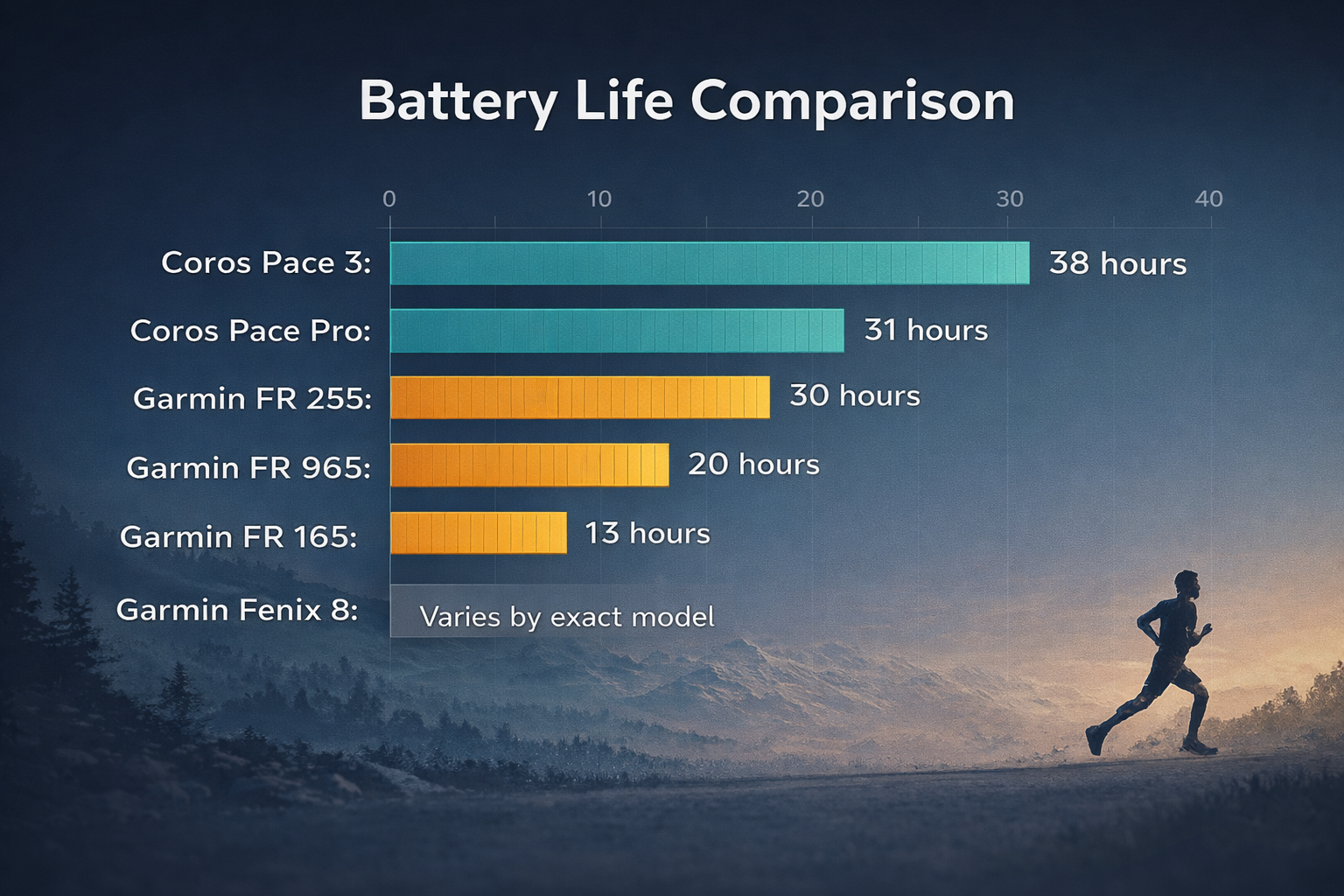
On the flip side, the AMOLED watches from Garmin require charging every 4 to 7 days depending on how much you use GPS, which means you’re thinking about charging multiple times per week if you’re training hard. That’s not terrible compared to an Apple Watch that needs daily charging, but it’s also not the weeks of battery life you get from MIP displays or the insane battery life from Coros. The trade off is that AMOLED displays look absolutely gorgeous, they’re easier to read at night, and they make the entire user experience feel more modern and premium.
For most runners, I think the sweet spot is either the Coros Pace 3 if you prioritize battery life and don’t care about ecosystem polish, or the Garmin Forerunner 165 if you want a nice display with good battery life and the Garmin ecosystem. Both watches give you accurate GPS, solid heart rate monitoring for training purposes, and enough features to train intelligently without overwhelming you with data you’ll never use. The more expensive watches are fantastic if you need their specific features, multiband GPS for the 255, topographic maps for the 965, or dive capability for the Fenix 8, but those features only matter if you’ll actually use them.
The worst thing you can do is buy an expensive watch with features you never use and then let it die because you forgot to charge it. I’ve been there too many times, which is why battery life has become my obsession. A watch that’s dead is useless no matter how many features it has, and a watch that tracks your runs accurately with weeks of battery life is useful even if it doesn’t have maps or music or contactless payments. Keep that in mind as you make your decision, and don’t let marketing convince you that you need features that don’t actually improve your training.
Comparison Table: All Six Watches
| Watch | Price | Display | Battery (GPS) | Battery (Smart) | GPS Type | Best Feature |
|---|---|---|---|---|---|---|
| Coros Pace 3 | $229 | 1.2″ MIP | 38 hours | 24 days | Dual frequency | Insane battery life |
| Garmin FR 165 | $249-299 | 1.2″ AMOLED | ~13 hours | 4 days | All systems | Cheapest AMOLED |
| Garmin FR 255 | $349-399 | 1.3″ MIP | 30 hours | 14 days | Multiband | Cheap Multiband GPS |
| Coros Pace Pro | $349 | 1.3″ AMOLED | 31-38 hours | 6 days | Dual frequency | AMOLED with maps |
| Garmin FR 965 | $599 | 1.4″ AMOLED | ~20 hours | 6-7 days | Multiband | Premium AMOLED |
| Garmin Fenix 8 | $999+ | 1.3-1.4″ AMOLED/MIP | Varies | 6+ days AMOLED | Multiband | Dive capability |
Frequently Asked Questions
Q: Do I really need multiband or dual frequency GPS?
A: For most runners, no. The Garmin Forerunner 165 has regular all systems GPS and it was virtually identical in accuracy to Garmin’s multiband watches in testing. Multiband helps most in really challenging environments like city streets with tall buildings, dense forests, or mountains with cliffs, but even in those conditions the accuracy improvement is often marginal. If you run mostly on roads, trails, or tracks, regular GPS is perfectly fine.
Q: Is an AMOLED display worth the shorter battery life?
A: That depends on how you value aesthetics versus battery life. AMOLED displays are gorgeous and make the entire user experience feel more premium, but they require charging multiple times per week instead of once every week or two. If you’re diligent about charging and you want a watch that feels modern, AMOLED is great. If you hate thinking about charging or you do long activities regularly, MIP displays give you way more battery life.
Q: Should I get a Garmin or a Coros?
A: Garmin has more ecosystem polish, better training metrics, more refined user interfaces, and better third party app support. Coros has better battery life, competitive GPS accuracy, and lower prices, but training metrics are less refined and the ecosystem is more bare bones. If you want the most complete package and don’t mind paying for it, get Garmin. If you prioritize battery life and value, get Coros.
Q: Do I need onboard maps?
A: Only if you’re doing trail running or hiking in unfamiliar areas where you need navigation. For road running, track workouts, or familiar routes, you don’t need maps at all. Breadcrumb trail navigation with turn by turn alerts is enough for most people, and you can always use your phone if you need detailed maps in an emergency.
Q: How accurate is optical heart rate compared to a chest strap?
A: For steady state running and most training, optical heart rate from the wrist is good enough. It struggles more with really high intensity intervals, cold weather starts, and outdoor cycling, but for 80% to 90% of your training it’s accurate enough to train by. If you’re doing serious interval training or you need perfect accuracy for every single workout, get a chest strap. For everyone else, wrist based is fine.
Q: Can I use these watches for cycling and swimming too?
A: The Forerunner 255, 965, and Fenix 8 all have full multisport and triathlon support with cycling power meter compatibility and open water swimming modes. The Forerunner 165 has pool swimming and cycling but not triathlon mode or power meter support. The Coros watches have cycling and swimming but the heart rate accuracy for outdoor cycling is terrible, so you’d want a chest strap for cycling workouts.
Q: Which watch has the best GPS accuracy?
A: In testing, all the Garmin watches had excellent GPS accuracy, and the Coros Pace 3 and Pace Pro also performed very well. The Garmin watches with multiband GPS (FR 255, 965, Fenix 8) were slightly more accurate in challenging environments but the differences were often marginal. Don’t choose a watch solely on GPS accuracy, all six of these watches track accurately enough that it won’t meaningfully impact your training.
Where to Buy
All six watches are available from major retailers including Amazon, REI, and the manufacturers’ websites. Prices are accurate as of February 2026 but watch for sales, especially on older models like the Forerunner 255 which sometimes drops below $300 during promotions. Garmin watches typically go on sale during Black Friday and holiday shopping seasons, while Coros watches rarely see discounts since their prices are already aggressive.
If you’re buying a Garmin watch, consider getting it from REI if you’re a member since they offer a very generous return policy and you earn dividend rewards. For Coros watches, buying directly from their website ensures you’re getting the latest firmware and avoids potential issues with gray market units.
About the Author: Sarah Okafor is a contributing editor at Race Pace Review specializing in running gear and technology. When Sarah’s not testing running gears she’s running trails, fixing her bike, or arguing with her Garmin about whether she’s actually recovered yet.
Disclosure: Race Pace Review may earn affiliate commissions from purchases made through links in this article, which helps fund our testing and keeps the site running. We only recommend products we’ve actually tested and would buy with our own money.